
Westlands packs an affluent commercial district into a compact urban sub-county: Nairobi City County projects 344,626 residents across 98 km² in 2025, a density of 3,517 people per km². That scale helps explain why the area feels less like a quiet suburb than a mixed urban centre, where apartment towers, serviced residences, offices, malls, hotels and late-night venues reinforce one another. The property data are not one-directional.
HassConsult recorded an 11.5% annual fall in apartment sale prices in 2025, yet rents held around KSh134,000 per month, while Cytonn placed the area first among Nairobi office nodes by rent and yield. The result is a district whose appeal depends on more than prestige. Its housing market, business traffic, retail clusters and evening economy all show how Nairobi’s demand for convenience is being priced, packaged and concentrated.
Who lives in Westlands and what the housing looks like
The area associated with gated compounds and polished apartments is not low-density: Westlands sub-county is projected at 344,626 people in 2025 and 354,695 by 2027 across 98 km², implying a 2025 density of 3,517 people per km², according to Nairobi City County. That figure helps explain why the residential character feels urban and compact even where individual properties are large, secure, and set back from the road.
Why the area attracts offices, hotels and business traffic
Office rents of KSh120 per sq ft and occupancy of 82.8% made the neighbourhood Nairobi’s top commercial-office node in Cytonn Research’s 2025 ranking, ahead of the metropolitan average yield of 7.8%. Those figures point to sustained tenant demand and explain why formal workplaces are concentrated within a relatively small area. The pattern is visible along Waiyaki Way, Ring Road, Parklands Road and nearby feeder streets, where glass office blocks and mixed-use towers give the commercial core a denser profile than surrounding residential pockets.
Corporate tenants are drawn by the short distance between offices, banks, meeting venues and client-facing hospitality. This clustering reduces friction for firms that depend on frequent meetings, executive travel or professional services, while also supporting weekday demand for cafés, lunch spots, printing services, couriers and ride-hailing. The same concentration helps landlords command premium office rents, since the value lies not only in floor space but in access to a ready business ecosystem.
Hotel development follows the same logic. On 18 March 2025, Hyatt announced the opening of two properties in the area, adding 168 rooms and 8,514 sq ft of meeting space, according to Hyatt Hotels Corporation. The meeting-space component is significant because it shows that newer hotels are not serving overnight visitors alone; they are also built for conferences, corporate training, project teams and regional business travel.
The practical effect is a neighbourhood that is busiest during working hours, when private cars, taxis and delivery motorcycles converge around offices and hotels. This daytime activity supports employment and keeps surrounding services busy, but it also increases congestion and pressure on parking. Commercial density therefore brings convenience and economic activity, while making road access and building-level traffic management part of daily business operations.
Restaurants and retail around The Mall and Westlands Market
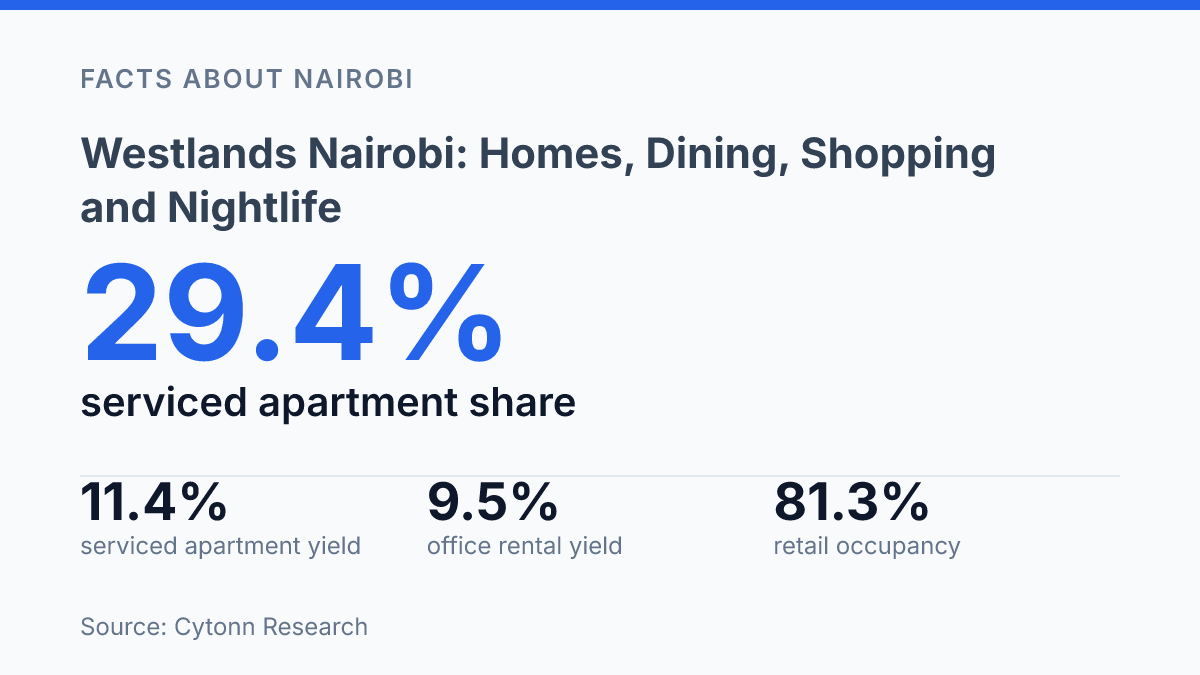
Retail space around The Mall commands some of Nairobi’s stronger suburban prices, with Cytonn Research putting local retail rents at KSh264 per sq ft in 2025. The same data reported 81.3% retail occupancy and a 9.5% rental yield, indicating that shops, cafés and service outlets benefit from steady demand rather than relying only on weekend footfall. This helps explain why formal shopping centres remain prominent: they serve nearby residents, office workers, hotel guests and visitors moving through the district during the day.
The main retail anchors combine enclosed malls with more traditional market activity. The Mall remains one of the area’s recognisable commercial landmarks, while Westlands Market provides a more informal shopping environment with small traders, everyday goods and local food vendors. Other shopping centres, including Sarit Centre and Westgate, broaden the offer with supermarkets, fashion outlets, electronics, pharmacies, banks and casual dining, making the area practical for routine errands as well as discretionary spending.
Food choices reflect the same split between premium consumption and everyday convenience. Nairobi Feast’s 2026 directory lists 49 dining spots in the area, a count that captures both the density and variety of its restaurant scene.
Indian restaurants are especially visible, reflecting long-established Nairobi dining patterns and demand from families, business groups and visitors; Italian options add another layer through pizzerias, pasta-focused restaurants and higher-end casual venues. These sit alongside cafés, bakeries and quick-service counters that cater to workers looking for shorter daytime meals.
The broader food mix is not limited to formal restaurants. Traditional street food remains part of the local eating culture, particularly around market edges, transport points and busy pedestrian routes, where roasted maize, samosas, bhajia, grilled meat and tea stalls offer cheaper alternatives to mall dining. The contrast is important: the district’s most visible retail and restaurant spaces often target higher-spending customers, but the surrounding streets and market activity keep the area accessible to a wider cross-section of shoppers and diners.
Bars, clubs and evening activity
A 2026 nightlife directory by Usiku lists 36 Nairobi venues overall, with several clubs and rooftop bars in this district appearing among the first dozen entries, including 11:11 Club, Brew Bistro Rooftop, Ciel Club and Covo. That concentration helps explain why the neighbourhood’s identity changes noticeably after office hours: it is not only a place to work, eat and shop, but also one of Nairobi’s better-known evening destinations.
Bars and clubs extend the area’s commercial day into a later social economy. Residents have entertainment close to home, while hotel guests, office workers and visitors from other parts of the city add to the evening footfall. Rooftop venues, cocktail bars and dance clubs also fit the neighbourhood’s denser, mixed-use character, where hospitality, dining and entertainment are clustered within relatively short distances rather than separated into single-purpose zones.
This after-dark activity works in tandem with the area’s food and retail offer. Restaurants often provide the bridge between daytime errands or business meetings and later social plans, while bars and clubs keep spending in the district after many conventional shops have closed. The result is a longer trading cycle for hospitality operators and a stronger lifestyle reputation for the neighbourhood as a whole.
The same concentration can place pressure on surrounding streets. Late-night arrivals and departures increase demand for parking, ride-hailing pick-ups and roadside waiting space, while music and crowd movement can create noise concerns near residential buildings. These effects do not erase the economic value of the evening scene, but they show why nightlife is both a defining attraction and a planning issue in a compact urban district.
The capacity question behind the next phase
The next phase will likely be shaped less by whether the district remains desirable than by how much density its roads, parking, security systems and public spaces can absorb. Westlands already shows a split market: sale prices can weaken even when rents, hotel demand and office occupancy remain firm. That makes timing and property type more significant than the area label alone.
For residents, the practical question is proximity to work and services versus noise, traffic and higher daily costs. For investors and operators, the clearest signal is in income stability rather than headline prices, especially where serviced apartments, retail frontage and hospitality demand overlap within a walkable radius.
Frequently Asked Questions
Q: What is Westlands in Nairobi known for?
A: Westlands is known for its mix of upscale housing, office towers, hotels, restaurants, shopping centers and nightlife. It has a strong expat presence alongside wealthy Kenyan residents, which shapes both the residential market and the local business scene.
Q: Is Westlands a good place to live in Nairobi?
A: Westlands is often considered a desirable residential area because it combines large houses, bungalows and chic apartments with access to offices, retail and dining. The area’s affluence and central location have made it attractive to professionals, expats and higher-income households.
Q: What kind of food can be found in Westlands?
A: Westlands has a broad dining scene that includes Indian and Italian restaurants, as well as outlets serving traditional street food. The concentration of restaurants around leafy streets and commercial buildings makes it one of Nairobi’s best-known food districts.
Q: Where do people shop in Westlands?
A: Shopping in Westlands is centered on places such as The Mall, Westlands Market and other shopping centers. These retail hubs serve both everyday needs and higher-end consumer demand, reflecting the area’s mix of residents and office workers.
Q: Is Westlands good for nightlife?
A: Westlands is one of Nairobi’s main nightlife areas, with bars and clubs forming a major part of its evening economy. Its concentration of restaurants, hotels and entertainment venues means the district stays active well beyond office hours.