
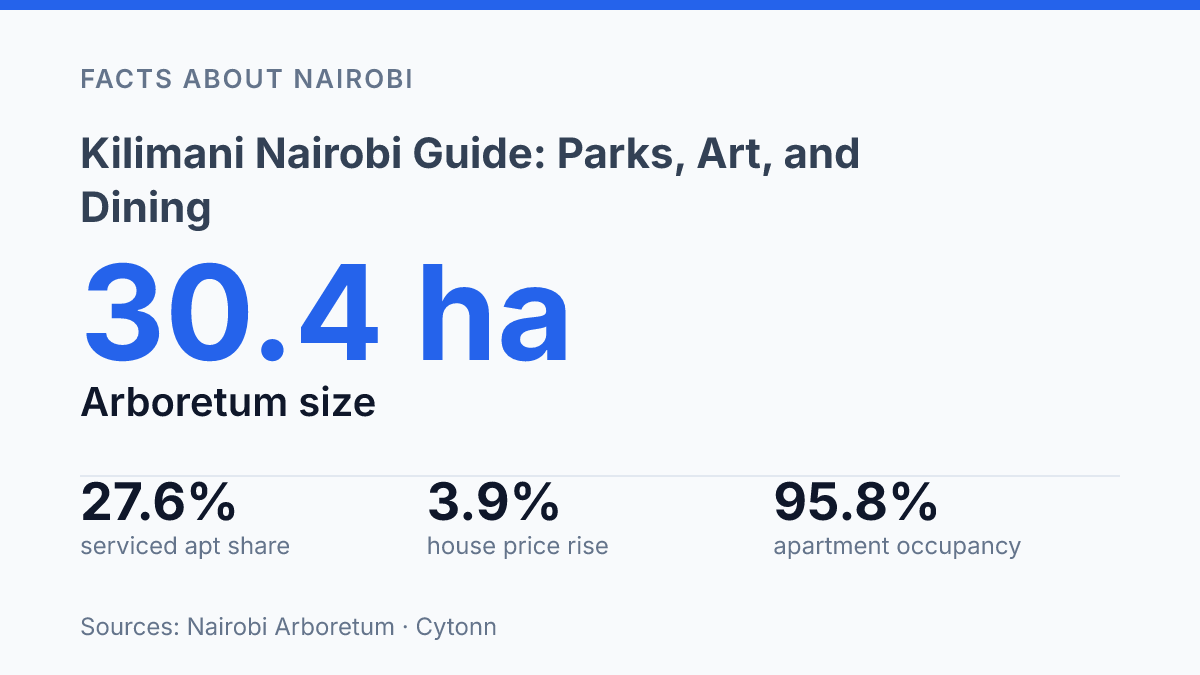
Kilimani posted a 3.9% quarter-on-quarter house-price rise in Q1 2026, placing it behind only Lavington and Spring Valley among the Nairobi suburbs highlighted by Cytonn. That market signal explains part of its pull, but not the whole address: the same area recorded apartment occupancy of 95.8% in FY2025, while nearby civic and leisure assets range from the 30.4-hectare Nairobi Arboretum to the reopened Uhuru Park.
The area’s appeal sits at the intersection of residential demand, serviced-apartment activity, walkable errands, and access to cultural and public spaces. This guide examines how those pieces fit together, from investment markers and everyday conveniences to art venues, modern buildings such as FCB Mihrab, and the green routes and memorial sites that shape the wider neighbourhood experience.
What makes Kilimani a sought-after Nairobi address
Few Nairobi suburbs compress commuter convenience, apartment demand, and mall-led daily errands into as small a central-western footprint as Kilimani. The area sits in Nairobi’s central-western corridor, close enough to the city center to serve professionals with cross-town routines while remaining primarily residential in character. That position helps explain why it attracts long-term residents, short-stay guests, diplomatic households, and businesses seeking an address that is central without being inside the core business district.
The built environment reflects that mixed demand. Apartment blocks now define much of the area, especially along the busier roads, while older low-rise homes, diplomatic residences, and compact office buildings still shape quieter side streets. This blend gives the neighborhood a practical rather than purely suburban feel: weekday movement is shaped by school runs, office traffic, serviced apartments, errands, and evening dining, not by one single land use.
Demand has also made the address more expensive and denser than many nearby residential areas. According to Cytonn, house prices rose 3.9% quarter-on-quarter in Q1 2026, behind only Lavington at 4.2% and Spring Valley at 4.0% among the highlighted Nairobi suburbs. That price movement points to continued confidence in the area, but it also explains the visible pressure for redevelopment, with larger plots often giving way to higher-density apartment projects.
Yaya Centre is the main commercial anchor that turns the neighborhood’s residential demand into everyday convenience. Located about 5 km from the city center and operating as a seven-day shopping destination, the mall concentrates supermarkets, services, restaurants, and shops in one place; Yaya Hotel & Apartments describes the complex as having close to 100 stores. Its presence reduces the need for residents and visitors to travel into the city center for routine needs, while also reinforcing the area’s appeal to serviced-apartment operators and office tenants.
Parks, memorials, and walking routes nearby
A 30.4-hectare pocket of tree cover near one of Nairobi’s most developed residential districts gives local walking routes a degree of variety that the built streets alone cannot provide. The Nairobi Arboretum contains roughly 350 indigenous and exotic tree and plant species, plus more than 100 recorded bird species, according to the Nairobi Arboretum. Its hilly paths make it one of the more practical nearby places for light hiking, jogging, and shaded walks, while still remaining an urban green space rather than a wilderness area.
Uhuru Park provides a different kind of open space: civic, central, and closely tied to public life. The National Tourism Service Portal lists the park at 12.9 hectares, or 32 acres, and records that it first opened on 23 May 1969 before reopening to the public on 30 March 2024 with no entry fee. Its lawns, walkways, and gathering areas have long made it a setting for leisure, public events, and informal recreation, so its value lies as much in access and shared use as in scenery.
Freedom Corner adds a memorial layer to the area’s public-space network. The memorial was inaugurated on 12 September 2015 after a 2013 settlement covering 5,228 claimants and totalling £19.9 million, according to GOV.UK and the British High Commission Nairobi. Its significance comes from its link to victims of the 1950s colonial regime, making it a public heritage site rather than simply a landmark within a park.
Together, these sites offer relief from dense development without changing the character of the neighbourhood into a green district. Their usefulness can depend on maintenance, safety, event schedules, and access conditions at a given time, which means they are best understood as specific public assets rather than a uniform recreational zone.
Art spaces and modern architecture
A 25-storey Islamic-inspired tower and a working artists’ collective give the area a cultural profile that is visible but not evenly distributed. FCB Mihrab is the clearest architectural marker: a modern commercial building that uses Islamic design language rather than treating the façade as a neutral glass box. According to Capital FM Business, it opened on 11 October 2017 as a KSh 1.3 billion project and was already 50% sold at launch, evidence that its design ambition sat within a commercially viable property model rather than apart from it.
Cafes, restaurants, and daily errands
A coffee meeting near Yaya Centre can turn into a supermarket stop, a pharmacy run, and dinner without leaving the same compact commercial orbit. Around the mall, trendy cafés work as informal daytime infrastructure: places for remote work, quick breakfasts, mid-afternoon meetings, and short waits between errands. Their concentration matters because it reduces the planning burden for routine visits; meals and practical stops sit close enough together that the neighbourhood functions less like a single-purpose residential zone and more like a daily-service district.
Global restaurants broaden that pattern by serving both Nairobi residents and international guests rather than a single dining niche. Menus and service styles around the main retail streets commonly reflect this mixed audience, with casual cafés, hotel-adjacent dining, and independent restaurants drawing on local, regional, and international tastes. Cytonn’s 2025 Nairobi Metropolitan Area Serviced Apartments Report placed the neighbourhood second in serviced-apartment market share at 27.6%, behind Westlands, which helps explain why restaurants near the commercial core cater to longer-stay visitors as well as nearby households.
For errands, the mall remains the easiest reference point because it combines shopping, services, parking, and recognizable meeting places in one address. Residents use it for practical tasks, while visitors use it as a navigational anchor before meals or appointments nearby.
This convenience is also the source of the area’s more commercial feel: foot traffic, ride-hailing pickups, deliveries, and restaurant turnover keep the streets active well beyond standard shopping hours. The result is useful rather than quiet, especially around peak meal times and weekends when dining plans and errands overlap.
Why street-level evidence matters most
The area’s strongest signal is not a single amenity or quarterly price rise, but the way several forms of demand overlap in a compact urban district. Residential buyers, renters, serviced-apartment operators, office users, cafe customers, and park visitors all read the same streets through different needs. That mix can support resilience, but it also makes building choice, street condition, parking, noise, and management quality more decisive than suburb-level averages.
The practical next step is to compare individual blocks and buildings against the headline data. In a district where a mall, memorial, office tower, and apartment block can sit within a short radius, value is often decided at ground level.
Frequently Asked Questions
Q: What are the main attractions in Kilimani, Nairobi?
A: Kilimani combines green space, public memorials, art venues, and dining. Nairobi Arboretum offers hilly hiking trails, while Uhuru Park includes the Freedom Corner memorial, which honors victims of the 1950s colonial regime. The area also has Kuona Artists Collective, the FCB Mihrab building, and restaurant clusters near Yaya Centre.
Q: Is Kilimani a good area for walking and outdoor activities?
A: Yes, the area supports short walks and trail-based outings, especially around Nairobi Arboretum. The park’s hilly terrain makes it more suitable for light hiking than flat leisure strolling. Uhuru Park also adds a central green space for visitors looking for open-air time.
Q: What can visitors see at Nairobi Arboretum and Uhuru Park?
A: Nairobi Arboretum is known for its hilly hiking trails and wooded setting. Uhuru Park is notable for the Freedom Corner memorial, which commemorates victims of the 1950s colonial regime. Together, they give the district a mix of recreation and historical context.
Q: Where can art lovers go in Kilimani?
A: Kuona Artists Collective is the main destination for contemporary African art in the area. It is known for giving artists a place to display and work on their pieces. The FCB Mihrab building also stands out for its modern interpretation of Islamic architecture.
Q: Where are the best places to eat in Kilimani?
A: Trendy cafes and global restaurants are concentrated around Yaya Centre, which is one of the area’s main dining hubs. This makes the district convenient for casual meals and more varied international food options. The restaurant scene is closely tied to the mall rather than spread evenly across the neighborhood.