
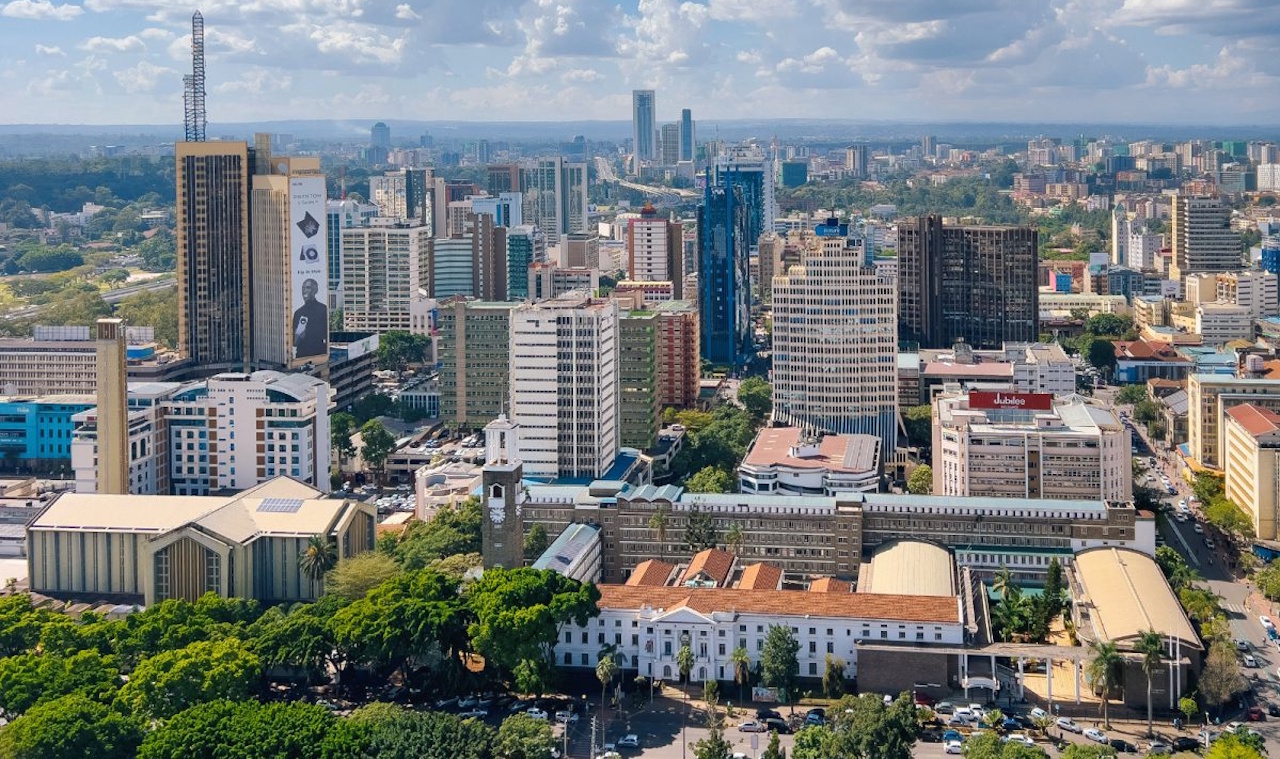
The answer to “What is Nairobi best known for?” starts with a measurable imbalance: in 2024, Nairobi generated 27.5% of Kenya’s total Gross Value Added, while 33 of the country’s 47 counties each produced less than 2.0%. That economic weight explains why the city is often described first as Kenya’s command center for services, finance, government, transport, and international meetings. Yet Nairobi’s identity is not defined by offices alone.
Jomo Kenyatta International Airport handled 8,754,580 passengers in 2024, Nairobi National Park covers 117 sq km about 10 km from the central business district, and a 2025 food-environment study mapped 3,458 vendors across different neighbourhood types. The city is best understood through this overlap: a capital where global institutions, safari imagery, commuter commerce, markets, and street food sit unusually close together.
Kenya’s capital and East Africa’s main business hub
One county generates more than a quarter of Kenya’s recorded gross value added, which explains why Nairobi is treated as more than a seat of government. In 2024, Nairobi City contributed 27.5% of Kenya’s total Gross Value Added, while 33 of the country’s 47 counties each contributed less than 2.0%, according to KNBS. That imbalance shows why the city is commonly understood as Kenya’s primary economic centre, especially for services, administration, finance, and formal employment.
Kenya’s national government is anchored in Nairobi, with State House, Parliament, ministries, courts, and major regulatory bodies concentrated in the capital. This administrative role reinforces the city’s commercial importance because policy-making, procurement, diplomacy, and corporate decision-making often cluster near the same institutions. For businesses operating nationally, Nairobi offers proximity to both government offices and the largest concentration of professional services in the country.
The city’s regional profile is also strengthened by the presence of major international institutions. Nairobi hosts the headquarters of the United Nations Environment Programme and UN-Habitat, making it one of the few cities in the Global South with a major UN headquarters role. That status brings diplomatic missions, conference activity, technical agencies, and policy networks into the city’s everyday economy, extending its influence beyond Kenya’s borders.
Finance and transport complete the picture. The Nairobi Securities Exchange gives the city a central role in capital markets, while Jomo Kenyatta International Airport connects Kenya to regional and intercontinental routes. Rail links, including the standard gauge railway connection toward Mombasa, support the movement of passengers and freight between the capital, the coast, and inland markets.
Nairobi’s dominance has practical costs as well as advantages. Concentrated jobs, institutions, and transport links increase pressure on roads, housing, land prices, and public infrastructure. The same forces that make the city a business centre also help explain its congestion, uneven service provision, and high demand for formal and informal housing.
Why wildlife is central to the city’s identity
A national park with lions and black rhinos sits about 10 km from Nairobi’s central business district, a proximity that few capital cities can match. According to the Kenya Wildlife Service, Nairobi National Park covers 117 sq km, was gazetted in 1946, and supports more than 100 animal species and more than 400 bird species. Its wildlife includes lions, rhinos, giraffes, buffaloes, zebras, antelopes, and many smaller species, making the city’s international image unusually tied to large mammals rather than only to government, commerce, or transport.
The park’s location is the defining contrast behind Nairobi’s wildlife reputation. It is not simply that wildlife exists near the city, but that open savanna, skyline views, and major urban infrastructure sit within the same frame.
That contrast helps explain why images of giraffes or lions with city buildings in the background have become among Nairobi’s most recognizable visual markers. Visitor numbers also show that the association is not only symbolic: the KNBS Economic Survey 2025 recorded 431.2 thousand visitors to Nairobi National Park in 2024, up from 402.7 thousand in 2023, while visits to the Nairobi Safari Walk rose from 216.6 thousand to 286.2 thousand over the same period.
Other conservation sites reinforce this identity by making wildlife care and education part of the city experience. The David Sheldrick Wildlife Trust is closely associated with elephant rescue and rehabilitation, while the Giraffe Centre is known for Rothschild’s giraffe conservation and public education. These sites differ from the national park in scale and purpose, but together they keep conservation visible within the urban area rather than placing it only in distant reserves.
The same proximity that makes Nairobi distinctive also creates a long-term management challenge. Wildlife habitat at the city edge must be protected while surrounding land uses continue to expand and compete for space. Nairobi’s wildlife brand therefore depends not only on the presence of animals, but on maintaining the ecological room that allows a capital city and large mammals to remain closely connected.
Culture, markets, and everyday city life
A PMC-indexed study from 2025 mapped 3,458 food vendors across three Nairobi neighbourhood types, showing how strongly the city’s public life is shaped by eating, vending, and small-scale trade. The study found that cooked street-food or roadside caterers and tabletop vendors, often including mama mboga vegetable sellers, each made up 25% of the mapped vendors, while kiosks accounted for 16.7% and ambulant vendors or hawkers for 16%. That pattern helps explain why Nairobi is often understood through everyday movement and exchange, not only through formal attractions.
Museum culture gives the city another layer of public identity. The National Museums of Kenya and the Nairobi National Museum help anchor Nairobi’s cultural and historical reputation through exhibitions connected to heritage, natural history, archaeology, art, and national memory. These institutions matter because they place the city within a broader Kenyan and East African historical frame, giving residents, students, researchers, and visitors a structured point of reference for understanding the country’s past and cultural diversity.
Markets give that cultural image a more immediate and commercial form. Maasai Market is widely associated with crafts, beadwork, textiles, leather goods, sandals, carvings, and souvenir shopping, while City Market is commonly linked with local goods, fresh produce, flowers, meat, and small traders. Their reputations are different but complementary: one is often described through artisan retail and visitor shopping, the other through older urban market routines and everyday commerce.
Neighbourhood identity also shapes how Nairobi is discussed. Westlands is commonly associated with restaurants, bars, malls, offices, and evening leisure, while Karen is often linked with lower-density residential areas, gardens, cafés, and heritage sites. Kilimani is frequently mentioned in relation to apartments, dining, retail, and a changing residential profile.
These associations are useful, but they do not describe the whole city. Nairobi’s cultural image is uneven and varied, with some districts strongly tied to leisure and consumption while others are defined by commuting, informal trade, dense housing, and visible inequality.
What visitors usually associate with Nairobi first
Few African capitals are remembered as both a seat of government and a safari gateway before visitors have left the metropolitan area. That combination makes Nairobi unusually easy to place in global memory: it is not only Kenya’s capital, but also a city where wildlife sits close enough to shape the visitor image of the capital itself.
Asked “What is Nairobi best known for?”, the most concise answer is wildlife beside a major capital, supported by its role as East Africa’s business and transport base. Many cities are known for government districts, airports, markets, or museums; far fewer African capitals combine that scale of urban activity with a national park close to downtown. That contrast is why the wildlife-capital pairing tends to stand out more strongly than any single cultural attraction.
Visitors also associate Nairobi with movement: arrivals, meetings, onward travel, and the practical rhythm of a capital city. This hub identity does not replace the wildlife image; it reinforces it, because many travellers encounter the city as both a destination and a gateway. The result is a place known less for one monument than for an uncommon overlap of administration, commerce, conservation, and everyday urban life.
Compared with other Kenyan destinations, Nairobi’s identity is urban first, but not only urban. Mombasa is more strongly linked with the coast, while the Maasai Mara is more narrowly associated with open-land safari. Nairobi is distinguished by holding several national roles at once: capital, regional hub, and wildlife city, with the last of these making the overall mix especially memorable.
Why Nairobi’s reputations are becoming harder to separate
Nairobi’s reputation is likely to become more layered rather than simpler. The planned US$340 million expansion of the UN complex in Gigiri points toward a larger diplomatic and conference role, while rising visits to Nairobi National Park show that wildlife remains a durable part of the city’s public image. These identities do not compete as separate labels; they reinforce the same practical reality.
Nairobi is a gateway because planes, institutions, parks, hotels, markets, and road networks concentrate in one metropolitan area. That concentration creates opportunity, but it also raises pressure on transport, public space, conservation edges, and everyday food systems. The more Nairobi grows, the more its best-known features depend on how well those shared urban systems hold together.
Frequently Asked Questions
Q: What makes Nairobi famous to visitors?
A: Nairobi is best known for its unusual mix of urban life and wildlife access. The city is associated with Nairobi National Park, major museums, and its role as a regional business and transport center. This combination makes it stand out from many other capital cities in Africa.
Q: Is Nairobi known for safaris?
A: Yes. Nairobi is one of the few capitals where safari experiences can begin close to the city, especially through Nairobi National Park and nearby wildlife attractions. That proximity allows short visits to combine city sightseeing with game viewing in a single trip.
Q: What cultural attractions is Nairobi known for?
A: The city is known for institutions such as the National Museum of Kenya and the Karen Blixen Museum. These sites provide historical context on Kenya’s natural history, art, and colonial-era heritage. They are a major part of Nairobi’s identity beyond business and transport.
Q: Why is Nairobi important in East Africa?
A: Nairobi serves as a major economic and administrative hub for Kenya and the wider region. It hosts international organizations, corporate headquarters, and key transport links, which gives it influence beyond its national role. That economic function helps explain its rapid growth and centrality in East African affairs.
Q: What local food is Nairobi known for?
A: Nairobi is known for a broad urban food scene that includes Kenyan staples and street foods such as nyama choma, samosas, and chapati. The city’s restaurants and markets reflect influences from many communities, so food is one of the clearest ways its cultural diversity is experienced.