
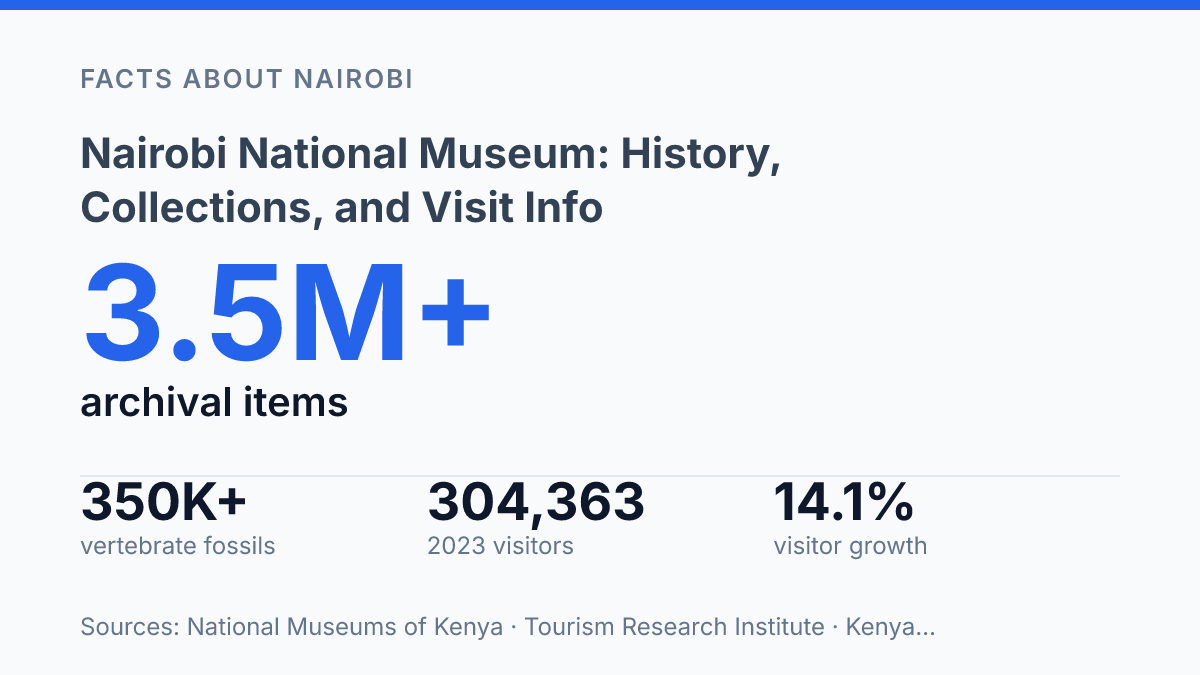
Nairobi National Museum drew 416.1 thousand visits with the Snake Park in 2025, up about 14.1% from 2024, according to Kenya’s 2026 Economic Survey. That growth points to a site that functions as more than a stop on a city itinerary: it is a public gateway to Kenya’s natural history, cultural records, scientific collections, and national memory. Its story also has an unusually clear timeline, from a 1910 natural history society collection to the Coryndon Museum opening in 1930, post-independence renaming in 1963, and a major reopening after modernisation in 2008.
The museum’s current identity is shaped by practical visitor details, six permanent galleries, and research holdings that extend far beyond display cases, including major fossil and archival collections. Understanding the museum means looking at both sides of its role: a visitor attraction on Museum Hill and a national knowledge institution.
What the museum covers and why it matters
A museum that curates more than 350,000 vertebrate fossils is not operating only as a display venue; it is also part of the evidence base through which East Africa’s past is studied. Nairobi National Museum sits within the National Museums of Kenya system, and its public galleries are linked to a wider institutional role in preserving, classifying, and interpreting heritage material. That makes its mandate broader than a conventional attraction built around one subject or one collection type.
Its core focus is East African heritage and history, expressed through exhibitions that bring together natural history, human origins, cultural life, political history, art, and material culture. National Museums of Kenya lists six permanent galleries for the site, including themes such as early humanity, mammals, Kenyan history, life-cycle traditions, currency, and Asian African heritage. The range matters because East African history is not treated as a single timeline; it is presented through biology, archaeology, social practice, exchange, governance, and identity.
The research role gives the museum a second function beyond public education. According to National Museums of Kenya’s Earth Science Department, the paleontology section curates more than 350,000 vertebrate fossils, including 1,000 early human remains.
Its archives also form part of a much larger documentary resource, with National Museums of Kenya reporting millions of archival materials alongside paintings, photographs, microfilms, and tapes. These holdings support scholarship as well as exhibition-making, since museum interpretation depends on catalogued objects, comparative material, and preserved records.
A broad mandate is the institution’s main strength and its main limitation as a visitor experience. It allows one museum to connect fossils, cultural heritage, national history, and visual material within a single public setting. The same breadth can make the museum feel less narrowly specialised than smaller institutions devoted to one subject, but that breadth is also what makes it a useful entry point into East African heritage as a connected field rather than a set of isolated topics.
How the museum started in 1910
A museum that began in 1910 as a natural history society project has had to recast itself more than once to remain a public institution rather than a colonial-era relic. According to NMK’s historical account, the institution started under the East Africa and Uganda Natural History Society, giving it an origin in collecting, documenting, and interpreting the natural world rather than in tourism alone.
Its early growth shows how quickly a small institutional base became part of Nairobi’s civic infrastructure. The museum moved to a larger building in 1922, land at Museum Hill was allocated in 1929, and the site opened as Coryndon Museum on 22 September 1930. Those steps matter because they mark a shift from society-led activity to a more permanent public setting, with dedicated space for preservation and education.
After independence, the institution was renamed in 1963, a change that aligned it more closely with Kenya’s national identity and public heritage responsibilities. Longevity gives the museum authority not simply because it is old, but because sustained custody allows records, objects, and research materials to be preserved across generations. That continuity helps explain its public value: heritage institutions become more useful when they can connect early collecting histories with later national narratives and contemporary interpretation.
Age alone does not guarantee relevance, and the museum’s later modernisation illustrates that point. NMK records that the museum closed for modernisation on 15 October 2005 and reopened in June 2008, indicating an effort to refresh how older material was presented to modern audiences. The result is a long-established Kenyan cultural institution whose credibility rests on both continuity and periodic renewal.
Where it is and how to contact it
The most precise public locator for the site is not only the road name but the junction marker: Museum Hill Express Way Super Junction. The street address is Kipande Rd, Nairobi, Kenya, placing the museum within central Nairobi’s Museum Hill area rather than in an outlying heritage precinct. That central position makes the address straightforward to identify on maps and listings, although travel times can still be affected by traffic around major junctions nearby.
For direct enquiries, the listed phone contact is Phone: +254 721 308485. This is the key detail for visitors who need confirmation of current visitor arrangements, group questions, or other time-sensitive information before arriving. The address should be written in full as Kipande Rd, Nairobi, Kenya when searching, booking transport, or recording the destination for formal purposes.
Recent attendance figures help explain why accurate contact and location details are useful: visitors to the museum and Snake Park increased from 364.6 thousand in 2024 to 416.1 thousand in 2025, a rise of about 14.1%, according to the Kenya National Bureau of Statistics, 2026 Economic Survey. Higher visitor numbers do not change the address or phone information, but they make clear that this is a heavily used public cultural site where planning details should be checked against official contacts rather than informal listings.
What visitors are likely to find inside
The strongest reason to allow more than a quick walk-through is that many displays are backed by research collections rather than assembled solely as visitor attractions. Inside Nairobi National Museum, exhibitions are likely to connect Kenyan history with wider East African heritage through objects, specimens, images, and interpretation that place local evidence in regional context. This gives the visit a broader purpose than viewing artefacts in isolation, because the material is arranged to explain how communities, environments, economies, and identities have changed over time.
Historical and cultural exhibitions typically work as a bridge between preserved heritage and public learning. Artefacts and visual records can show how social practices, political change, artistic expression, and everyday life have been documented, while explanatory text helps non-specialist visitors connect individual objects to larger patterns. The educational value comes from that relationship between evidence and interpretation: a displayed object is not only something to look at, but a prompt for understanding chronology, continuity, contact, and change.
The museum’s research role also shapes what visitors encounter. Collections held for study give curators and scholars reference material for classification, comparison, conservation, and teaching, and that institutional depth can make the public displays more authoritative. In practical terms, a visitor may see only a selected portion of the material, but those selections draw meaning from the wider body of preserved evidence behind them.
This research-led character creates a useful contrast with a simple display venue. A casual visit can still offer a clear introduction to Kenyan and regional heritage, but the museum rewards slower attention to labels, object groupings, and cross-references between natural, cultural, and historical material. The result is a visit oriented toward learning as much as sightseeing, especially for students, researchers, families, and travellers seeking context rather than only visual highlights.
What rising visits mean for the Museum Hill site
Rising visitor numbers create a useful pressure test for the Museum Hill site. A museum receiving more than 416,000 combined museum-and-Snake-Park visits a year must serve school groups, tourists, researchers, and local residents without reducing complex collections to quick stops. That tension is likely to shape how exhibitions, pricing, night tours, and research access develop in the coming years.
The practical consequence is that current details matter: admission category, opening hours, group requirements, and whether the Snake Park is included can change the cost and shape of a visit. The museum’s value lies not only in what is already preserved, but in how clearly that material remains accessible as demand grows.
Frequently Asked Questions
Q: What is the Nairobi National Museum known for?
A: The Nairobi National Museum is known for presenting East African heritage, history, and culture through its collections and exhibitions. It serves both as a public museum and a research institution, so the material on display is tied to wider study and preservation work.
Q: Where is the Nairobi National Museum located?
A: It is located at Museum Hill Express Way Super Junction, Kipande Rd, Nairobi, Kenya. The site is centrally placed in Nairobi, which makes it a common stop for visitors looking for history and cultural exhibits in the city.
Q: When was the Nairobi National Museum founded?
A: The Nairobi National Museum was founded in 1910. Its long history makes it one of the older cultural institutions in Kenya, and that background shapes the breadth of its collections.
Q: What kind of collections and exhibitions are there?
A: The museum focuses on East African heritage and history, with collections that support exhibitions on culture, natural history, and historical development. Because it also functions as a research group, its displays are often connected to documented regional scholarship.
Q: How can someone contact the museum for more information?
A: The museum can be reached by phone at +254 721 308485. That contact line is the most direct option for current visitor information, including practical questions about access or services.