
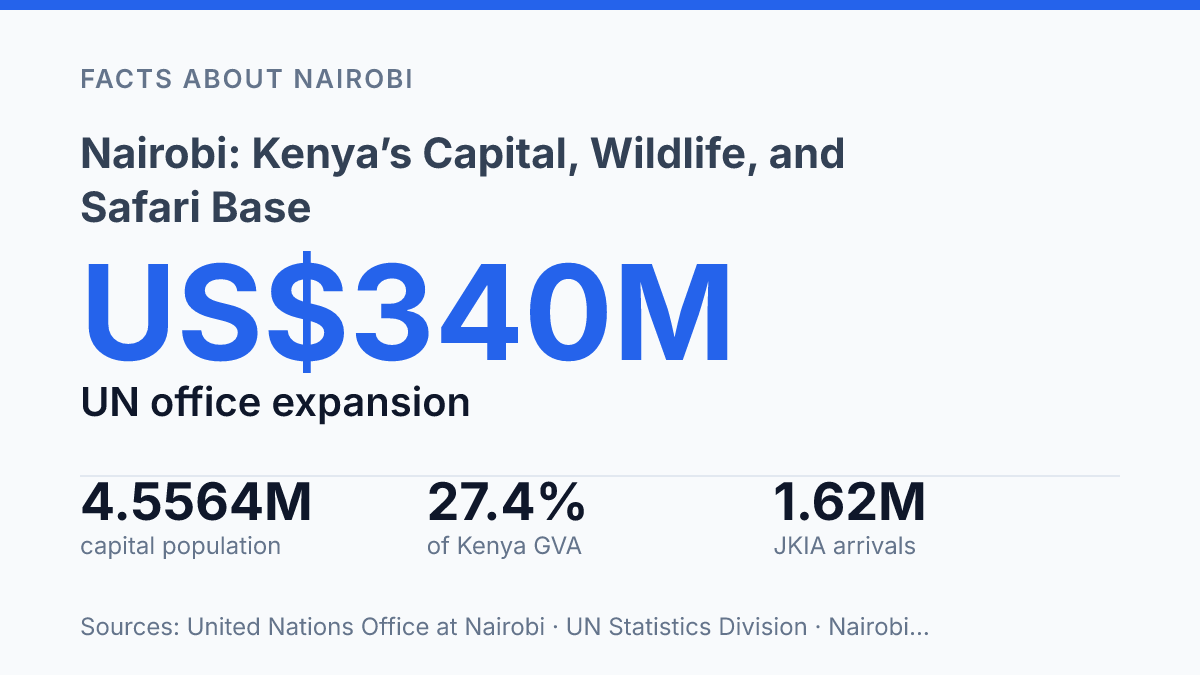
Nairobi generated 27.4% of Kenya’s national Gross Value Added in 2024, yet lions still hunt inside the capital’s commuter belt. That contradiction is the whole point. This isn’t a safari stop pretending to be a city, or a city using wildlife as a postcard.
It’s Kenya’s command room, a four-million-plus capital. The place where most visitors first touch down through Jomo Kenyatta International Airport.
The numbers explain the pull, but not the tension. A county with GCP per capita of KSh 850,332 also borders a national park that drew 431,165 visitors. Rhinos are thriving there, but space is tight.
Orphaned elephants are raised minutes from traffic. Flights arrive, meetings start, safari vehicles roll out before dawn. In my honest opinion, that uneasy mix is exactly why the capital matters more than most travel guides admit.
Why Nairobi Runs Kenya
One county generated 27.4% of Kenya’s Gross Value Added in 2024, with GCP per capita at KSh 850,332, according to the county fiscal strategy paper citing KNBS GCP. That is not just urban scale. It is national power concentrated in one place.
When Kenya became independent on 12 December 1963, Nairobi became the capital of the new nation. That decision locked the city into the machinery of government. Parliament, ministries, courts, regulators, foreign missions, and public agencies all pull decisions toward the same urban core.
Geography sharpened that role. The capital sits in south-central Kenya, near the Nairobi River and close to the country’s main transport corridors.
Routes linking the coast, the Rift Valley, central Kenya. The western border give the city reach that politics alone couldn’t create.
The population figure shows the weight behind the bureaucracy. The United Nations Statistics Division’s World Statistics Pocketbook 2024 listed the capital-city population at 4.5564 million. That means national decisions are made in a place larger than many countries’ entire urban systems.
But command comes with friction. The city moves fast, then slows hard.
Offices, freight, commuters, construction, and public services all compete for the same roads and land. Speed and congestion collide here… and that pressure shapes daily life more than postcard images do.
In my view, the capital matters because it doesn’t just host Kenya’s government. It concentrates the country’s choices. Budgets, permits, court rulings, corporate headquarters, and infrastructure plans all pass through its orbit.
That concentration creates opportunity. It also makes every delay feel national.
Nairobi National Park and the Wildlife Edge
Lions can move with office towers in sight here, a visual contradiction few capital cities can claim. Nairobi National Park opened in 1946, making it Kenya’s first national park. It still feels like an argument against tidy categories: city on one side, wild country on the other.
The protected area covers about 117 square kilometers, according to Kenya Wildlife Service. That isn’t vast by East African standards.
But its position makes it exceptional. You don’t travel far from the capital’s hard surfaces before the ground changes and the animals appear.
Endangered black rhinos give the park its strongest conservation weight. In July 2025, KWS Director General Erastus Kanga said the park held 126 black rhinos and 49 white rhinos, a total above its estimated ecological carrying capacity of 90 to 100 rhinos, as reported by The Star. That sounds like success.
It also exposes the pressure. Protection can create its own crowding problem when habitat is tight.
Giraffes, zebras, and lions live inside or near this edge as part of a wildlife system that hasn’t been pushed completely out. The sight is thrilling.
It isn’t soft. Roads, fences, settlement, and protected land all press against each other here.
Visitor numbers show how powerful the draw remains. The 2024 Annual Tourism Sector Performance Report recorded 431,165 visits to the park, making it one of Kenya’s most visited wildlife sites. In my honest opinion, the park matters most when it refuses to let visitors separate the city from the wild. Its beauty is real, but so is the warning built into it: wildlife survives here beside the capital, not apart from it.
The Elephant Orphanage Next Door
A nursery open to the public for one hour a day drew 455,550 visits in 2024, according to Kenya’s Annual Tourism Sector Performance Report. That number can make the place sound commercial. It isn’t.
The David Sheldrick Wildlife Trust allows the standard public visit from 11:00 a.m. to noon, and access is controlled through advance booking rather than open wandering at the gate. Visitors watch feedings and keeper talks from a set public area.
The point is not to handle calves. It’s to support and understand the care.
The Trust began in 1977, long before orphaned-elephant content became a social-media genre. Its work centers on milk formulas, keeper attachment, medical checks, and slow return to wild living. A cute hour at the rope line sits on top of a demanding system visitors barely see.
Care looks sentimental from the outside. The workload is exacting: as of 25 January 2024, the Trust said its city nursery held 21 orphaned elephants and two orphaned rhinos.
Each animal needs its own feeding schedule. Keepers must also prevent trust from hardening into dependence.
The intimacy is real. It isn’t the achievement. In my humble opinion, the discipline behind the rope is what gives the orphanage its moral weight.
If the visit only felt adorable, it would be thin. It matters because the public sees care without being allowed to disrupt it.
Why Travelers Use the City as a Safari Launch Point
More than two-thirds of Kenya’s international arrivals already land where most safari itineraries begin. According to the Tourism Research Institute’s Annual Tourism Sector Performance Report, Kenya received 2,394,376 international tourists in 2024, and Jomo Kenyatta International Airport handled 1,622,745 arrivals, or 68% of the total. That makes the capital the country’s main international gateway in a practical sense, not just a marketing one.
Tour operators build around that fact. Many safaris start with hotel pickups before dawn, then push west toward the Maasai Mara, south toward Amboseli, or southeast toward Tsavo. The pattern is simple: arrive, sleep, leave early.
A road transfer to the Mara commonly takes about five to six hours, depending on the gate and road conditions. Amboseli is often a four-hour drive. Tsavo trips usually follow the Mombasa Road corridor, with timings shaped by the specific lodge and park entrance.
Flying changes the rhythm. It doesn’t remove the city from the plan. Travelers often transfer from the international airport to Wilson Airport for light-aircraft flights to the Mara or Amboseli. Those hops can take roughly 45 minutes to an hour.
That saves a day of road time. It also adds strict baggage limits, weather delays. The cost of domestic air seats. Fast isn’t always simpler.
The smarter reason to start here is control. You can recover from a long-haul flight, meet your guide, change money, buy forgotten gear, and adjust the route before the dust roads begin. That matters when a safari depends on timing, vehicle quality, and clear logistics.
But treating the capital as a waiting room is a mistake. The city gives the safari its first context: traffic beside tour vans, conservation offices beside cafés, and wildlife experiences close enough to fit before or after a longer circuit. In my view, rush past it and you miss the place that makes the rest of the journey work.
What the capital asks you to notice before you leave
This capital will get harder to read as it grows. The UN’s May 2026 expansion points to bigger diplomacy, with conference capacity planned for 9,000 delegates. The park tells a different story: success can create pressure when rhinos outgrow easy space.
So don’t treat the city as a layover. Build in one slower day. Watch how government offices, airport logistics, the Sheldrick Wildlife Trust, and safari departures all depend on the same urban machine. In my humble opinion, the reward isn’t just better planning.
It’s a clearer sense of how Kenya balances ambition with living wildlife. If you leave seeing only animals or only traffic, you missed the harder truth: the capital is managing both at once.
Frequently Asked Questions
Q: Can you see wildlife in Nairobi without leaving the city?
A: Yes. Nairobi National Park sits right next to the urban core, and that’s the surprise most visitors don’t expect. You can see giraffes, zebras, and lions there, plus endangered black rhinos.
Q: Is Nairobi a good base for a Kenya safari?
A: Absolutely. Nairobi is the main jumping-off point for safari trips across Kenya. You can land, rest, and head out fast. That makes it practical. It also means the city gets skipped too quickly.
Q: What animals are in Nairobi National Park?
A: The park is home to giraffes, zebras, and lions. It also plays a major role in breeding endangered black rhinos, which gives it real conservation weight. That mix of city edge and serious wildlife protection is what makes it stand out.
Q: Can you visit an elephant orphanage in Nairobi?
A: Yes. The well-regarded elephant orphanage next to Nairobi National Park is run by the David Sheldrick Wildlife Trust. In my view, that stop matters because it adds a conservation angle, not just a photo opportunity.
Q: How far is Nairobi from safari destinations in Kenya?
A: Nairobi itself is the starting point, not the final safari stop. From there, travelers head to other parts of Kenya for longer game drives and lodge stays. That setup saves time. It also means you’ll want to plan your route carefully.