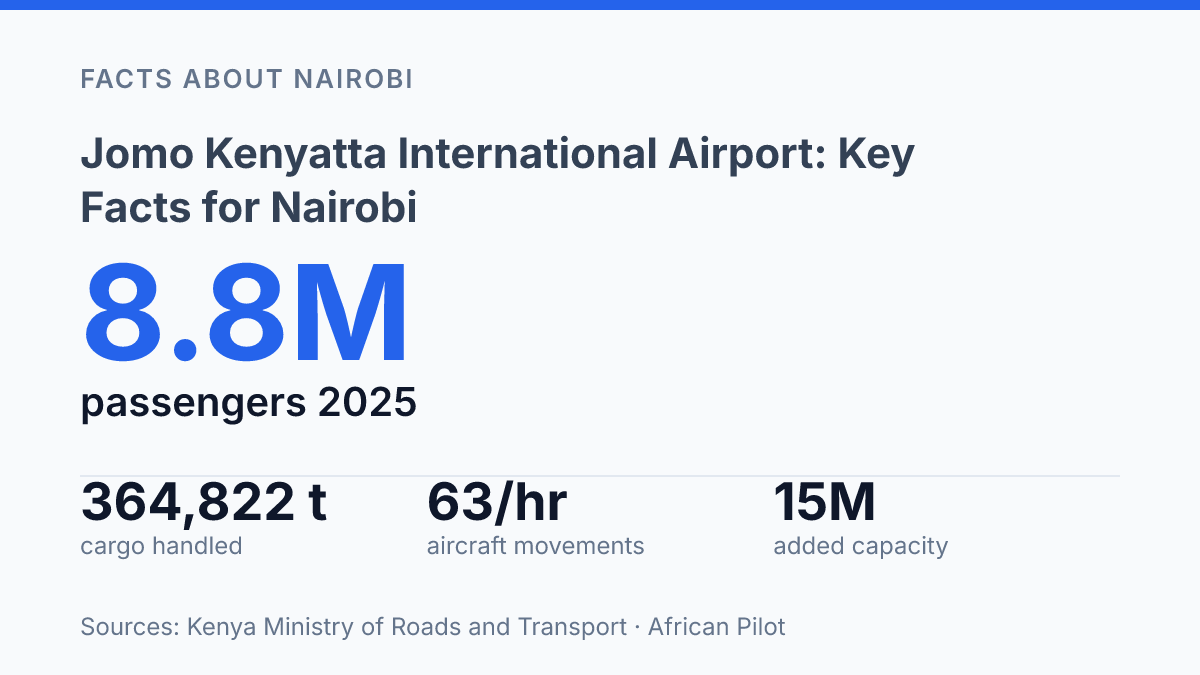
Jomo Kenyatta International Airport carried 8.8 million passengers in 2025, even though its current design capacity is 8 million. That gap matters.
It means Nairobi’s main airport isn’t just busy. It’s already being asked to do more than it was built to handle.
Set in Embakasi, about 18 km southeast of Nairobi’s CBD, JKIA serves the capital, domestic flyers, long-haul travellers, cargo operators, and regional connections that tie Kenya to the wider world. Its reach now stretches from Mombasa shuttles to a nonstop New York JFK route of more than 11,800 km.
But scale brings friction. Queues, customs checks, terminal pressure, and future expansion all shape the passenger experience.
In my honest opinion, the airport matters most when you stop seeing it as a building and start seeing it as Kenya’s front door.
Where the airport is and who it serves
The airport can feel both near and inconvenient: Embakasi puts it within Nairobi’s orbit, but not beyond the reach of the city’s worst road delays. Jomo Kenyatta International Airport sits in Embakasi, about 18 kilometres southeast of the central business district, and serves Nairobi, Kenya’s capital and largest city, according to the TOA Electronics reference page, 2026/accessed.
That location is the key to its role. It isn’t a remote outpost built far from the city it serves. It functions as Nairobi’s main international gateway, handling the core flow of overseas arrivals and departures for the country’s political, commercial, and tourism capital.
The distance sounds modest on paper. In practice, the trip can swing sharply depending on the time of day, the route taken. The pressure on Nairobi’s road network.
Close enough to act as the city’s front door, yes. Far enough out that a short transfer can become a long crawl.
Business travellers use it because Nairobi is Kenya’s command centre for finance, government, conferences, and regional offices. Tourists use it because the city is the usual starting point for safaris, domestic connections, and onward travel. Transit passengers use it because Kenya sits in a practical position between East Africa, the wider continent, and long-haul corridors.
In my view, its real value is not just that it serves the capital. It concentrates Nairobi’s international movement in one place, giving the city a clear aviation front door even when the road journey to that door tests your patience. The airport’s identity is tied to access, but access in Nairobi always comes with a traffic warning.
Flight network and global reach
Scheduled flights from JKIA reach destinations in over 50 countries, giving Kenya a route map that reaches far beyond its immediate region. According to Airportia in 2026, the airport appeared on 91 routes to 89 cities in 51 countries.
That’s not a small national gateway. It’s a working intercontinental connector.
The network covers the routes you’d expect, then stretches further. Regional African links connect passengers with cities such as Addis Ababa, Johannesburg, Kigali, Entebbe, and Dar es Salaam.
Middle East services open onward paths through Dubai, Doha, and similar Gulf connection points. Longer-haul flights tie the airport to Europe and Asia, including routes serving major business, diaspora, and tourism flows.
That reach is not just a bragging point. It gives exporters faster access to buyers, especially for time-sensitive goods.
It gives tour operators a wider pool of inbound markets. It also lets passengers move across Africa without routing every journey through Europe or the Gulf first. In my honest opinion, that last point is where the airport’s network matters most: it strengthens African connectivity on African terms.
But a broad route map creates pressure. Transfer passengers don’t judge an airport by dots on a map. They judge it by missed connections, queue times, baggage delivery, and whether peak travel periods feel controlled or chaotic.
Global access is the promise. Reliable handling is the proof.
For Kenya, the upside is clear. More city pairs mean more trade options, more visitor pathways, and more transit traffic passing through the country rather than around it.
The risk is just as clear. If demand grows faster than processing capacity, the network can start to feel bigger than the airport supporting it.
Why it matters to Kenya’s air travel system
One airport handling more passengers than it was built for tells you where Kenya’s aviation pressure really sits. In 2025, JKIA handled 8.8 million passengers against a stated annual capacity of 8 million, according to Kenya’s Ministry of Roads and Transport.
That gap isn’t just an operations detail. It shows how much of the country’s international travel depends on one facility.
For passengers, its real value is transfer power. A traveller from Kisumu, Eldoret, Malindi, or Mombasa can route through Nairobi and connect onward to international services without leaving the national air system.
That makes JKIA more than an arrival point. It works as Kenya’s main sorting room for people moving between local cities and overseas markets.
The comparison with Moi International Airport in Mombasa is useful. Moi matters deeply for the coast, tourism, and regional access.
Eldoret International Airport also serves a clear role, especially for western Kenya and freight-linked movement. But neither carries the same national concentration of long-haul passenger demand, airline connectivity, and domestic-to-international transfers.
That concentration gives Kenya reach. It also raises the stakes.
When queues build, systems slow, or flights miss connections, the disruption doesn’t stay inside one terminal. It spreads into business trips, safari itineraries, family travel, export schedules, and onward domestic legs. In my humble opinion, that concentration is both Kenya’s advantage and its risk.
This is why JKIA carries more national weight than its physical footprint suggests. It anchors the passenger system for inbound and outbound movement, then feeds that movement back into the domestic network.
Smaller airports extend Kenya’s reach. This one holds the centre.
What travellers should know before they go
A 15-hour nonstop flight can still be followed by a slow city approach if you land at the wrong time. FlightConnections listed Nairobi–New York JFK as the airport’s longest nonstop service, last updated July 2, 2026. That tells long-haul travellers something useful: this is a serious international arrival point, not a small regional stop with quick, predictable exits.
Your ticket and baggage tag will usually show the airport code NBO, though travellers in Kenya commonly call it JKIA. Inside the airport, the reference points that matter most are the passenger terminal areas, especially Terminal 1 and its sub-sections, plus Terminal 2.
Don’t treat “Terminal 1” as one simple doorway. For international departures and arrivals, the exact terminal reference can affect where you get dropped, where you meet someone, and how much time you lose moving around.
Getting from Nairobi’s core is the part travellers underestimate. Mombasa Road remains a key access corridor. The Nairobi Expressway has changed the rhythm of airport trips for many passengers.
But the airport’s convenience depends less on map distance than on timing. Peak-hour congestion can turn a reasonable transfer into a stressful one, especially before evening departures or after early arrivals.
International travellers should build in a buffer that fits the flight, not just the road. Long-haul check-in, document checks, security queues, and baggage flows all add friction. In my view, the smartest travellers treat the drive as part of the flight plan, not an afterthought.
Customs is another reason not to cut it fine on arrival. Kenya Revenue Authority guidance from 2023 says new goods worth up to USD 500 per traveller are exempt from import tax if accompanied and declared, but flagged baggage may still go through physical inspection after x-ray screening.
That won’t affect every passenger. When it does, it can change your first hour in Nairobi.
What the pressure at JKIA means before you fly
The next few years will decide whether JKIA feels merely crowded or genuinely ready for Nairobi’s growth. A new runway planned by 2029 could change how the airport breathes, especially if aircraft movement capacity rises as planned. But concrete alone won’t fix every delay.
Travellers still need to do the simple things well. Check terminal details early.
Leave room for traffic from the city. Declare goods properly, especially when the Kenya Revenue Authority exemption for new accompanied items sits at USD 500. In my humble opinion, that small preparation matters more than most airport guides admit.
The airport’s pressure is not a flaw to ignore. It’s the clearest sign that Nairobi has outgrown old assumptions.
Frequently Asked Questions
Q: How far is Jomo Kenyatta International Airport from Nairobi city centre?
A: It’s about 18 kilometres southeast of the city centre. That sounds close on a map, but traffic can stretch the trip more than you expect. Plan extra time if you’re flying during a busy hour.
Q: What area of Nairobi is the airport in?
A: It’s in Embakasi, a suburb on the southeast side of the city. That location puts it outside the core downtown area, which helps with airport access but doesn’t make the drive instant. You’ll still want to account for local traffic.
Q: Does Jomo Kenyatta International Airport have international flights?
A: Yes. It serves Nairobi and has scheduled flights to destinations in over 50 countries. That gives you a wide choice of routes. The exact options depend on the airline and season.
Q: Is Jomo Kenyatta International Airport the main airport in Nairobi?
A: Yes, it serves Nairobi, Kenya’s capital and largest city. That makes it the city’s key international gateway. In my view, for most travelers, this is the airport that matters first.
Q: How long does it take to get to Jomo Kenyatta International Airport from central Nairobi?
A: There isn’t one fixed answer, because road conditions can change fast. The airport is only 18 kilometres away. That doesn’t guarantee a quick ride. If you’re heading there for a flight, leave more time than the distance suggests.